


The IOC Introduces Stringent Rules To Tackle Ski Jumping’s ‘Crotch Hack’ Ahead of Milan Cortina Games
As per the recent controversy, ski jumpers reportedly injected hyaluronic acid into their male privates for better aerodynamics due to enlargement.
 Follow Us

Norwegian Ski jumper Marius Lindvik was accused of tampering with his crotch area on suit (Image via Milano Cortina 2026 Official Website)
The IOC officials officially introduced new rules in ski jumping in light of the growing controversy over the newly discovered doping mechanism. According to a news report by the German publication Bild last month, male ski jumpers were reportedly injecting hyaluronic acid into their penises to increase size and improve lift during flight during the Nordic World Ski Championships 2025.
The athletes reportedly underwent the procedure to enlarge their external genitalia, thereby increasing the crotch area on the suits. The increased surface area in the crotch area can trap more air and increase the athletes’ chances of staying airborne. Subsequently, with the increased lift, they will be able to perform longer jumps if the execution is right.
The benefits are plenty, with a bit more size around their privates, and hyaluronic acid can provide that. However, there needs to be a lot of hyaluronic acid injected. Poorly administered doses or injection techniques can lead to several short-term and long-term problems for the skier, ranging from pain in the groin to deformity and infection.
The International Olympic Committee and the World Anti-Doping Agency don’t want a bending of the rules to happen at the Winter Olympics. They have added a few measures ahead of the games starting soon. According to the newly implemented rules, skiers must undergo advanced 3D body-suit measurements and have tamper-proof microchips installed in the suits to prevent any unauthorized tampering.
In case of any deviation from the rules, there’s a yellow and red card system in place. Disqualification will lead to a yellow and red in case of any further violations. This would result in losses on both the athlete’s and the team’s side. The athlete will be disqualified from the next event, and the team will lose a skier spot.
Ski Jumping at the 2026 Winter Olympics in Milan and Cortina D’Ampezzo
The ski-jumping events will be underway in Giuseppe Dal Ben Ski Jumping Arena in Predazzo, Trentino, in northern Italy. The venue, inaugurated in 1989, has previously hosted three editions of the FIS Nordic Ski World Championships as well as a few events of the Ski Jumping World Cup.
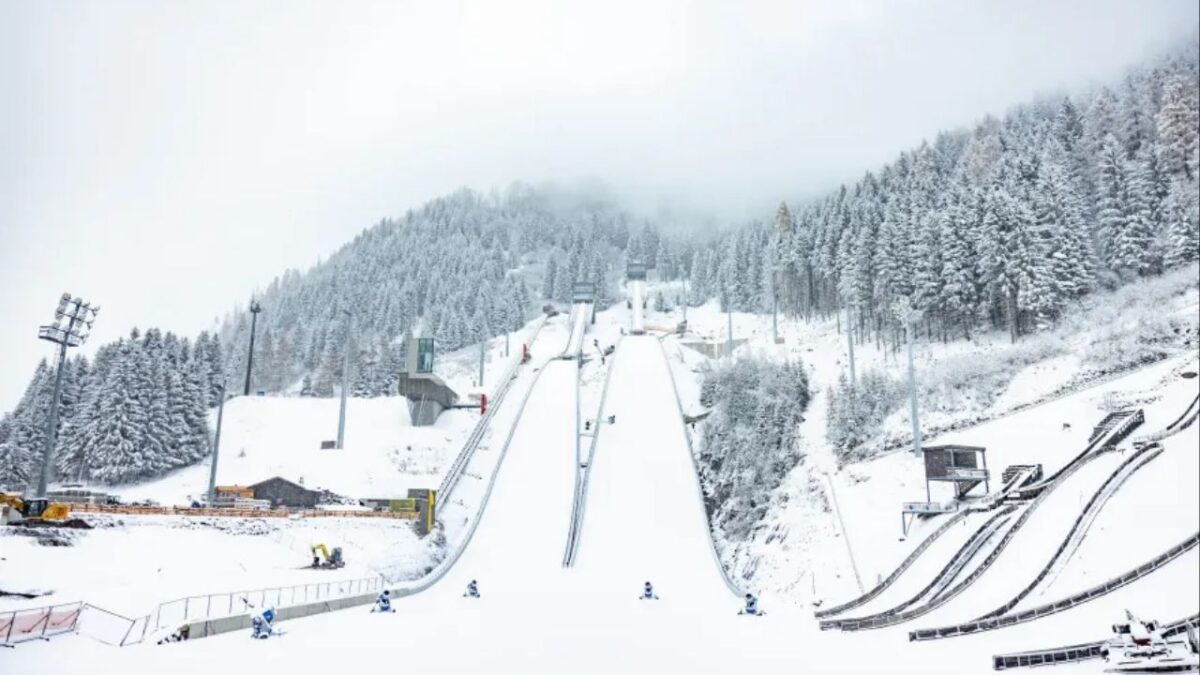
The Ski-Jumping events will start on February 7, 2026, with the Women’s Normal Hill Trial Round followed by the first round. In total, there are six events: men’s and women’s normal and large hill, men’s super team, and mixed team.
In the individual events, there’s a qualification round followed by the final round. The 30 best jumps in the qualification round make the final round. In the men’s super team event, two athletes from the same country compete as a team across three rounds, with both jumpers performing in every round. After the first round, the top 12 teams move forward, and the top eight teams qualify for the final round.
In the mixed team event, two men and two women from the same country compete together. It consists of two rounds, with the top eight teams from the first round advancing to the final. Only countries that have qualified at least two male and two female athletes for the individual events are allowed to participate in the mixed team competition.
Here’s the medal event schedule for ski jumping at the Milan Cortina games:
| Date/Time | Event |
|---|---|
| 2:45-5:05 p.m.; Saturday, February 7, 2026 | Women’s Individual Normal Hill🏅 |
| 1-3:20 p.m.; Monday, February 9, 2026 | Men’s Individual Normal Hill🏅 |
| 12:45-3:20 p.m.; Tuesday, February 10, 2026 | Mixed Team🏅 |
| 12:45-3:10 p.m.; Saturday, February 14, 2026 | Men’s Individual Large Hill🏅 |
| 12:45-3:10 p.m.; Sunday, February 15, 2026 | Women’s Individual Large Hill🏅 |
| 1-3:10 p.m.; Monday, February 16, 2026 | Men’s Super Team🏅 |
The key difference between the two will be the K-point, aka the point on the hill where it starts to flatten out. The normal hill, HS109, has a K-point range from 98m (about 322 feet). Normal Hill usually have K-point range from 85m to 99m. Meanwhile, the large hill in Predazzo, HS123, has a K-point of 128 meters or about 420 feet.
Also Read
- Google Debuted Curling Doodle Amid Winter Olympics Unofficially Opening With The Curling Preliminaries
- Team USA Flag Bearer Frank Del Duca Credits The Army For His Personal And Professional Growth



/techfirstnow/media/agency_attachments/kATjCXskQdJKkXN0OuqW.png)