

Jannik Sinner Faces Heavy Backlash After Marketa Vondrousova Receives 4-Year Ban for Refusing Anti-Doping Test – “He Is Overprotected”
Jannik Sinner tested positive for the banned anabolic steroid clostebol twice in 2024.
 Follow Us

Jannik Sinner, Marketa Vondrousova (Image via ATP Tour, BBC)
Marketa Vondrousova is slapped with a four-year ban from the International Tennis Integrity Agency (ITIA) just because she missed an anti-doping test. And as expected, many from the tennis world brought up Jannik Sinner‘s case and accused the anti-doping system of overprotecting high-profile players.
The former World No.6 refused the test last December. A Doping Control Officer (DCO) came to her home at around 8 p.m. on December 3 for an out-of-competition test.
In her defense, Vondrousova said she was not avoiding testing, but because she was dealing with injury, constant pressure, and sleep issues, it left her feeling exhausted. Plus, receiving hateful messages and threats online affected how safe she felt in her own space.
We understand that the testing process is uncomfortable and acknowledge that it is an additional burden for players whose jobs already come with a high level of pressure and scrutiny, but it is essential to protect fair competition.
ITIA CEO Karen Moorhouse said in a statement
The independent tribunal that conducted the investigation stated that Vondrousova’s explanation offered “no compelling justification” for the reason why she refused the test.
Safety and welfare of players and our testers is really important to us. Our testers are well-trained, professional, and the gender of our testing witness always matches the player. They carry ID at all times, and players are able to verify their identity in other ways if they are ever unsure.
Karen Moorhouse added
The reason she received a four-year ban is that she violated the anti-doping rule, according to which the punishment for refusing a test and a positive test is the same.
The independent tribunal ultimately supported that principle. This case is an important reminder that players can be tested at any time, in any place, and that refusal comes with significant risk.
Karen Moorhouse added
And this is why Sinner’s as well as Iga Swiatek‘s doping cases resurfaced. Both Sinner and Swiatek failed drug tests in 2024.
Sinner tested positive for the banned anabolic steroid clostebol twice in March, and the ITIA made the announcement in August the same year. Swiatek, in August, tested positive for banned heart medication trimetazidine, which contaminated melatonin she was taking for sleep issues. Both top players escaped lengthy bans because they were able to provide the source of contamination within the deadline given to them.
Fans slam Jannik Sinner and the ITIA after Marketa Vondrousova received a long ban
Marketa Vondrousova is 26 years old. So by the time the four-year ban ends, she will turn 30. For the life of an athlete, wasting four years on the sidelines is too much because their biggest asset is their body, and tennis players typically end their careers around 35. Fellow WTA players are sympathizing with the 2023 Wimbledon champion.
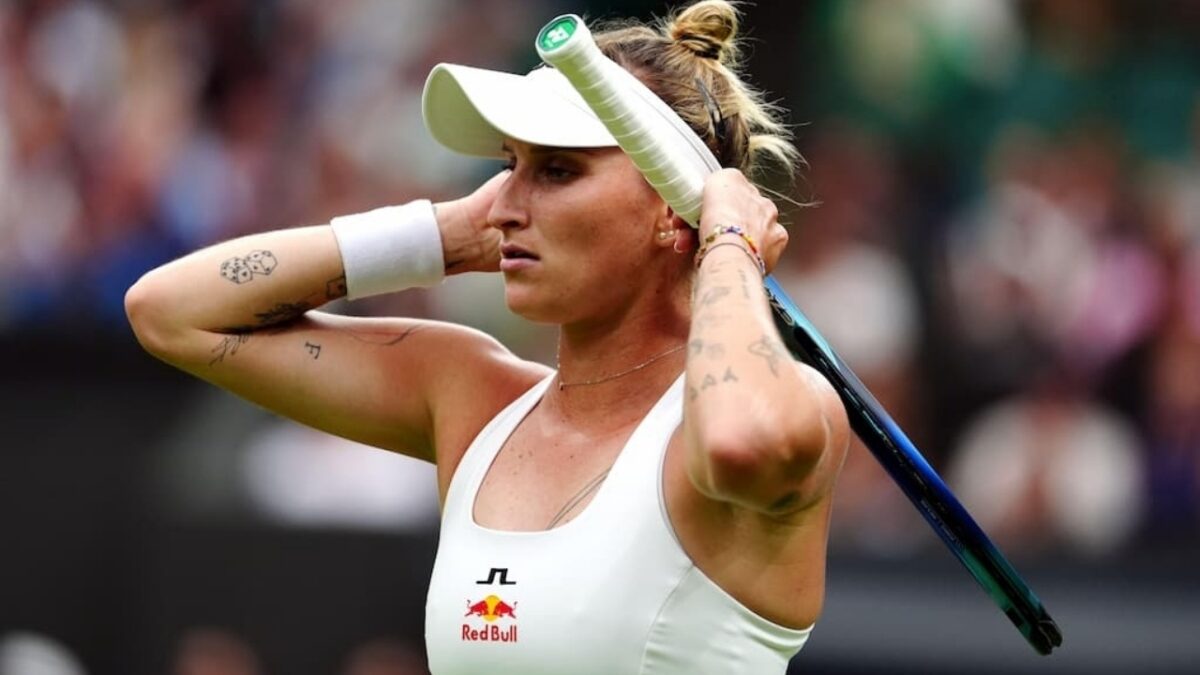
But fans online are divided. Some think Vondrousova is responsible for her own misfortune, with some even accusing her of doping. And then there are some who are convinced that Vondrousova’s case only confirms that the anti-doping rules really need an overhaul because of the way they handled Jannik Sinner and Iga Swiatek’s cases.
Check out their reactions here:
A player who has mental health issues refuses one time to take a test : 4 years.
— . (@Antetokounmp_OM) June 22, 2026
A player who has been convicted to use illegal products : 3 months suspension.
Sinner is overprotected by ITF
she never tested positive. Why do Sinner and Swiatek received different treatment? They both had positive test results. Very sad.
— Omairita (@Paciencia2023) June 22, 2026
And yet Sinner and Iga play on. Awesome system
— Dean Martelli (@damartelli) June 22, 2026
Corrupt system. Useless players’ councils to let this injustice keep happening. Swiatek/Sinner were treated as if they were the victims. They kept their cases secret, they gave them a month or two and let them choose when they wanted to take the break.
— Meazi MJ (@MeaziMJ) June 22, 2026
This is mad – so she hasn’t tested positive ? Yet Sinner did and wasn’t banned and was able to play.
— Jane MB (@juliamayb78) June 23, 2026
This is hilarious and insane. I understand a ban for refusing a test, but it being 4 years, when Sinner and Swiatek who both indeed tested positive only received 3 months, just proves that there are double standards in tennis.
— JmDesign15 🇷🇸 (@Design15Jm) June 22, 2026
Crazy how Sinner and Swiatek were allowed to do whatever they wanted when they were actually caught doping including to keep it secret, take their 1&4 month pathetic bans in times of their choice and Vondrousova gets 4yrs for not taking a test. To call it unfair is understatement
— Meazi MJ (@MeaziMJ) June 22, 2026
So, the players who had illegal substances received a 3 month suspension, while the one for the refusal received 4 years.
— Mara (@biberehumanum) June 22, 2026
This literally makes no sense at all!
When Sinner faced no punishment at first, the World Anti-Doping Agency (WADA) challenged ITIA’s decision and appealed to the Court of Arbitration for Sport (CAS). But after his win at the Australian Open last year, WADA withdrew the appeal, and though they initially wanted to ban Sinner for a year or two, they handed him just a three-month ban, which ended before the French Open, meaning he did not miss any Major. Swiatek faced just a one-month ban.
Sinner will next be seen in action at Wimbledon, the main draw of which starts on June 29. Swiatek will start her campaign on the grass swing at the Bad Homburg Open.
Gouri Das
(7956 Articles Published)